





 |
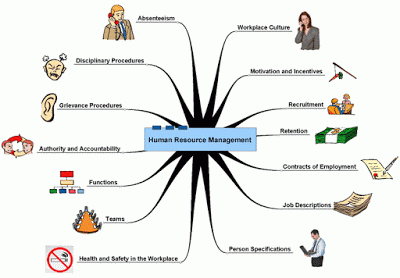
| Ruang Lingkup dunia HRD |
Tampilkan postingan dengan label Manajemen Sumber Daya Manusia. Tampilkan semua postingan
Tampilkan postingan dengan label Manajemen Sumber Daya Manusia. Tampilkan semua postingan
Senin, 21 Juli 2014
Rabu, 08 Mei 2013
Waktu Kerja Karyawan Sesuai Undang Undang Ketenagakerjaan
Sebagai Karyawan ada baiknya bagi anda untuk tahu dan
memahami hal-hal dibawah ini. Apakah aturan jam kerja kita sesuai dengan
undang-undang ketenagakerjaan, apakah aturan yang ada di perusahaan terasa
berbeda ?
Semoga menambah wawasan anda dan mencerdaskan setiap karyawan di
seluruh indonesia atas eksploitasi oleh oknum yang tidak bertanggung jawab
akibat ketidaktahuan anda. Maju Karyawan Indonesia

Sabtu, 16 Februari 2013
ebook / buku gary yukl Leadership in Organizations

Buku Leadership in Organizations memberikan keseimbangan antara teori dan praktek karena survei, teori utama dan penelitian tentang kepemimpinan dan efektivitas manajerial dalam organisasi formal.
Edisi kedelapan ini meliputi contoh-contoh baru, kutipan, dan pedoman, dan telah ditingkatkan untuk presentasi.
Ebook / buku Organizational Behavior (15th Edition) by Stephen P. Robbins
 Robbins / judge menyajikan penelitian yang relevan dalam gaya penulisan yang jelas bagi pembaca.
Diterima secara global dan ditulis oleh salah satu penulis yang paling terkemuka di bidangnya, buku ini adalah bacaan yang diperlukan untuk semua manajer, pekerja sumber daya manusia, dan siapa pun yang butuh untuk memahami dan meningkatkan keterampilan kepemimpinan mereka.
Minggu, 08 Juli 2012
TEORI HIRARKI KEBUTUHAN MASLOW

Teori motivasi yang paling terkenal adalah hierarki teori kebutuhan milik Abraham Maslow. Ia membuat hipotesis bahwa dalam setiap diri manusia terdapat hierarki dari lima kebutuhan, yaitu fisiologis (rasa lapar, haus, seksual, dan kebutuhan fisik lainnya), rasa aman (rasa ingin dilindungi dari bahaya fisik dan emosional), sosial (rasa kasih sayang, kepemilikan, penerimaan, dan persahabatan), penghargaan (faktor penghargaan internal dan eksternal), dan aktualisasi diri (pertumbuhan, pencapaian potensi seseorang, dan pemenuhan diri sendiri).
Maslow memisahkan lima kebutuhan ke dalam urutan-urutan. Kebutuhan fisiologis dan rasa aman dideskripsikan sebagai kebutuhan tingkat bawah sedangkan kebutuhan sosial, penghargaan, dan aktualisasi diri sebagai kebutuhan tingkat atas. Perbedaan antara kedua tingkat tersebut adalah dasar pemikiran bahwa kebutuhan tingkat atas dipenuhi secara internal sementara kebutuhan tingkat rendah secara dominan dipenuhi secara eksternal.
Teori kebutuhan Maslow telah menerima pengakuan luas di antara manajer pelaksana karena teori ini logis secara intuitif. Namun, penelitian tidak memperkuat teori ini dan Maslow tidak memberikan bukti empiris dan beberapa penelitian yang berusaha mengesahkan teori ini tidak menemukan pendukung yang kuat. (wikipedia)


TEORI X & Y DOUGLAS MCGREGOR
 Teori X dan Y diungkapkan oleh Douglas McGregor yang mengemukakan strategi kepemimpinan efektif dengan menggunakan konsep manajemen partisipasi. Konsep terkenal dengan menggunakan asumsi-asumsi sifat dasar manusia. Pemimpin yang menyukai teori X cenderung menyukai gaya kepemimpinan otoriter dan sebaliknya, seorang pemimpin yang menyukai teori Y lebih menyukai gaya kepemimpinan demokratik. Untuk kriteria karyawan yang memiliki tipe teori X adalah karyawan dengan sifat yang tidak akan bekerja tanpa perintah, sebaliknya karyawan yang memiliki tipe teori Y akan bekerja dengan sendirinya tanpa perintah atau pengawasan dari atasannya. Tipe Y ini adalah tipe yang sudah menyadari tugas dan tanggung jawab pekerjaannya.
Teori X
- Hampir semua karyawan malas dan tidak suka bekerja
- Pada umumnya karyawan tidak berambisi mencapai prestasi yang optimal dan selalu menghindarkan tanggung jawabnya dengan cara mengkambinghitamkan orang lain
- Karyawan lebih suka dibimbing, diperintah dan diawasi dalam melaksanakan pekerjaannya
- Karyawan lebih mementingkan diri sendiri dan tidak mempedulikan tujuan organisasi.
Menurut teori X ini untuk memotivasi karyawan harus dilakukan dengan cara pengawasan yang ketat, dipaksa dan diarahkan supaya mereka mau bekerja sungguhsungguh. Jenis motivasi yang diterapkan adalah cenderung kepada motivasi negatif yakni dengan menerapkan hukuman yang tegas.
Tipe kepemimpinan teori X adalah otoriter sedangkan gaya kepemimpinannya berorientasi pada prestasi kerja.
Teori Y
- Rata-rata karyawan rajin dan menganggap sesungguhnya bekerja sama wajarnya dengan bermain-main dan beristirahat. Pekerjaan tidak perlu dihindari dan dipaksakan, bahkan banyak karyawan tidak betah dan merasa kesal jika tidak bekerja.
- Lazimnya karyawan dapat memikul tanggung jawab dan berambisi untuk maju dengan mencapai prestasi kerja yang optimal.
- Karyawan selalu berusaha mencpaai sasaran organisasi dan mengembangkan dirinya untuk mencapai sasaran itu. Organisasi seharusnya memungkinkan karyawan mewujudkan potensinya sendiri dengan memberikan sumbangan pada tercapainya sasaran perusahaan.
Menurut teori Y ini untuk memotivasi karyawan hendaknya dilakukan dengan cara peningkatan partisipasi karyawan, kerjasama dan keterikatan pada keputusan. Tegasnya, dedikasi dan partisipasi akan lebih menjamin tercapainya sasaran.
Jenis motivasi yang diterapkan adalahg motivasi positif, sedangkan tipe kepemimpinannya adalah kepemimpinan partisipatif.(Literatur Ekonomi)
TEORI KEBUTUHAN MCCLELLAND
 David Clarence McClelland (1917-1998) mendapat gelar doktor dalam psikologi di Yale pada 1941 dan menjadi profesor di Universitas Wesleyan. McClelland dikenal untuk karyanya pada pencapaian motivasi. David McClelland memelopori motivasi kerja berpikir, mengembangkan pencapaian berbasis teori dan model motivasi, dan dipromosikan dalam perbaikan metode penilaian karyawan, serta advokasi berbasis kompetensi penilaian dan tes. Ide nya telah diadopsi secara luas di berbagai organisasi, dan berkaitan erat dengan teori Frederick Herzberg.
David McClelland dikenal menjelaskan tiga jenis motivasi, yang diidentifikasi dalam buku ”The Achieving Society”:
1. Motivasi untuk berprestasi (n-ACH)
2. Motivasi untuk berkuasa (n-pow)
3. Motivasi untuk berafiliasi/bersahabat (n-affil)
Model Kebutuhan Berbasis Motivasi McClelland
David McClelland (Robbins, 2001 : 173) dalam teorinya Mc.Clelland’s Achievment Motivation Theory atau teori motivasi prestasi McClelland juga digunakan untuk mendukung hipotesa yang akan dikemukakan dalam penelitian ini. Dalam teorinya McClelland mengemukakan bahwa individu mempunyai cadangan energi potensial, bagaimana energi ini dilepaskan dan dikembangkan tergantung pada kekuatan atau dorongan motivasi individu dan situasi serta peluang yang tersedia.
Teori ini memfokuskan pada tiga kebutuhan yaitu kebutuhan akan prestasi (achiefment), kebutuhan kekuasaan (power), dan kebutuhan afiliasi.
Model motivasi ini ditemukan diberbagai lini organisasi, baik staf maupun manajer. Beberapa karyawan memiliki karakter yang merupakan perpaduan dari model motivasi tersebut.
A. Kebutuhan akan prestasi (n-ACH)
Kebutuhan akan prestasi merupakan dorongan untuk mengungguli, berprestasi sehubungan dengan seperangkat standar, bergulat untuk sukses. Kebutuhan ini pada hirarki Maslow terletak antara kebutuhan akan penghargaan dan kebutuhan akan aktualisasi diri. Ciri-ciri inidividu yang menunjukkan orientasi tinggi antara lain bersedia menerima resiko yang relatif tinggi, keinginan untuk mendapatkan umpan balik tentang hasil kerja mereka, keinginan mendapatkan tanggung jawab pemecahan masalah.
n-ACH adalah motivasi untuk berprestasi , karena itu karyawan akan berusaha mencapai prestasi tertingginya, pencapaian tujuan tersebut bersifat realistis tetapi menantang, dan kemajuan dalam pekerjaan. Karyawan perlu mendapat umpan balik dari lingkungannya sebagai bentuk pengakuan terhadap prestasinya tersebut.
B. Kebutuhan akan kekuasaan (n-pow)
Kebutuhan akan kekuasaan adalah kebutuhan untuk membuat orang lain berperilaku dalam suatu cara dimana orang-orang itu tanpa dipaksa tidak akan berperilaku demikian atau suatu bentuk ekspresi dari individu untuk mengendalikan dan mempengaruhi orang lain. Kebutuhan ini pada teori Maslow terletak antara kebutuhan akan penghargaan dan kebutuhan aktualisasi diri. McClelland menyatakan bahwa kebutuhan akan kekuasaan sangat berhubungan dengan kebutuhan untuk mencapai suatu posisi kepemimpinan.
n-pow adalah motivasi terhadap kekuasaan. Karyawan memiliki motivasi untuk berpengaruh terhadap lingkungannya, memiliki karakter kuat untuk memimpin dan memiliki ide-ide untuk menang. Ada juga motivasi untuk peningkatan status dan prestise pribadi.
C. Kebutuhan untuk berafiliasi atau bersahabat (n-affil)
Kebutuhan akan Afiliasi adalah hasrat untuk berhubungan antar pribadi yang ramah dan akrab. Individu merefleksikan keinginan untuk mempunyai hubungan yang erat, kooperatif dan penuh sikap persahabatan dengan pihak lain. Individu yang mempunyai kebutuhan afiliasi yang tinggi umumnya berhasil dalam pekerjaan yang memerlukan interaksi sosial yang tinggi.
McClelland mengatakan bahwa kebanyakan orang memiliki kombinasi karakteristik tersebut, akibatnya akan mempengaruhi perilaku karyawan dalam bekerja atau mengelola organisasi.
Karakteristik dan sikap motivasi prestasi ala Mcclelland:
a). Pencapaian adalah lebih penting daripada materi.
b). Mencapai tujuan atau tugas memberikan kepuasan pribadi
yang lebih besar daripada menerima pujian atau pengakuan.
c). Umpan balik sangat penting, karena merupakan ukuran sukses
(umpan balik yang diandalkan, kuantitatif dan faktual).
Penelitian David Mcclelland
Penelitian McClelland terhadap para usahawan menunjukkan bukti yang lebih bermakna mengenai motivasi berprestasi dibanding kelompok yang berasal dari pekerjaan lain. Artinya para usahawan mempunyai n-ach yang lebih tinggi dibanding dari profesi lain.
Kewirausahaan adalah merupakan kemampuan kreatif dan inovatif yang dijadikan dasar, kiat dan sumberdaya untuk mencari peluang sukses (Suryana, 2006). Kreativitas adalah kemampuan mengembangkan ide dan cara-cara baru dalam memecahkan masalah dan menemukan peluang (Suryana, 2006). Inovasi adalah kemampuan menerapkan kreativitas dalam rangka memecahkan masalah dan menemukan peluang (Suryana, 2006). Ciri-ciri pokok peranan kewirausahaan (McClelland, 1961 dalam Suyanto, 1987) meliputi Perilaku kewirausahaan, yang mencakup memikul risiko yang tidak terlalu besar sebagai suatu akibat dari keahlian dan bukan karena kebetulan, kegiatan yang penuh semangat dan/atau yang berdaya cipta, tanggung jawab pribadi, serta pengetahuan tentang hasil-hasil keputusan; uang sebagai ukuran atas hasil.
Ciri lainnya, minat terhadap pekerjaan kewirausahaan sebagai suatu akibat dari martabat dan ‘sikap berisiko’ mereka. Seorang wirausaha adalah risk taker. Risk taker dimaksudkan bahwa seorang wirausaha dalam membuat keputusan perlu menghitung risiko yang akan ditanggungnya. Peranan ini dijalankan karena dia membuat keputusan dalam keadaan tidak pasti. Wirausaha mengambil risiko yang moderat, tidak terlalu tinggi (seperti penjudi), juga tidak terlalu rendah seperti orang yang pasif (Hanafi, 2003). Dari hasil penelitiannya, McClelland (1961) menyatakan bahwa dalam keadaan yang mengandung risiko yang tak terlalu besar, kinerja wirausaha akan lebih tergantung pada keahlian- atau pada prestasi - dibanding pekerjaan lain.
Seorang wirausaha untuk melakukan inovasi atau pembaharuan perlu semangat dan aktif. Mereka bisa bekerja dalam waktu yang panjang, misal 70 jam hingga 80 jam per minggu. Bukan lama waktu yang penting, namun karena semangatnya mereka tahan bekerja dalam waktu yang panjang. Bagi individu yang memiliki n-ach tinggi tidak begitu tertarik pada pengakuan masyarakat atas sukses mereka, akan tetapi mereka benar-benar memerlukan suatu cara untuk mengukur seberapa baik yang telah dilakukan.
Dari penelitiannya, McClelland menyimpulkan bahwa kepuasan prestasi berasal dari pengambilan prakarsa untuk bertindak sehingga sukses, dan bukannya dari pengakuan umum terhadap prestasi pribadi. Selain itu juga diperoleh kesimpulan bahwa orang yang memiliki n-ach tinggi tidak begitu terpengaruh oleh imbalan uang, mereka tertarik pada prestasi. Standar untuk mengukur sukses bagi wirausaha adalah jelas, misal laba, besarnya pangsa pasar atau laju pertumbuhan penjualan.
TEORI DUA FAKTOR FREDERICK HERZBERG

Frederick Herzberg (1923-2000), adalah seorang ahli psikolog klinis dan dianggap sebagai salah satu pemikir besar dalam bidang manajemen dan teori motivasi. Frederick I Herzberg dilahirkan di Massachusetts pada 18 April 1923. Sejak sarjana telah bekerja di City College of New York. Lalu tahun 1972, menjadi Profesor Manajemen di Universitas Utah College of Business. Hezberg meninggal di Salt Lake City, 18 Januari 2000.
Teori Dua Faktor Hezberg
Frederick Herzberg (Hasibuan, 1990 : 177) mengemukakan teori motivasi berdasar teori dua faktor yaitu faktor higiene dan motivator. Dia membagi kebutuhan Maslow menjadi dua bagian yaitu kebutuhan tingkat rendah (fisik, rasa aman, dan sosial) dan kebutuhan tingkat tinggi (prestise dan aktualisasi diri) serta mengemukakan bahwa cara terbaik untuk memotivasi individu adalah dengan memenuhi kebutuhan tingkat tingginya.
Menurut Hezberg, faktor-faktor seperti kebijakan, administrasi perusahaan, dan gaji yang memadai dalam suatu pekerjaan akan menentramkan karyawan. Bila faktor-faktor ini tidak memadai maka orang-orang tidak akan terpuaskan (Robbins,2001:170).
Menurut hasil penelitian Herzberg ada tiga hal penting yang harus diperhatikan dalam memotivasi bawahan (Hasibuan, 1990 : 176) yaitu :
a. Hal-hal yang mendorong karyawan adalah pekerjaan yang menantang yang mencakup perasaan berprestasi, bertanggung jawab, kemajuan, dapat menikmati pekerjaan itu sendiri dan adanya pengakuan atas semua itu.
b. Hal-hal yang mengecewakan karyawan adalah terutama pada faktor yang bersifat embel-embel saja dalam pekerjaan, peraturan pekerjaan, penerangan, istirahat dan lain-lain sejenisnya.
c. Karyawan akan kecewa bila peluang untuk berprestasi terbatas. Mereka akan menjadi sensitif pada lingkungannya serta mulai mencari-cari kesalahan.
Herzberg menyatakan bahwa orang dalam melaksanakan pekerjaannya dipengaruhi oleh dua faktor yang merupakan kebutuhan, yaitu :
a. Maintenance Factors
Adalah faktor-faktor pemeliharaan yang berhubungan dengan hakikat manusia yang ingin memperoleh ketentraman badaniah. Kebutuhan kesehatan ini merupakan kebutuhan yang berlangsung terus-menerus, karena kebutuhan ini akan kembali pada titik nol setelah dipenuhi.
b. Motivation Factors
Adalah faktor motivator yang menyangkut kebutuhan psikologis seseorang yaitu perasaan sempurna dalam melakukan pekerjaan. Factor motivasi ini berhubungan dengan penghargaan terhadap pribadi yang berkaitan langsung denagn pekerjaan.
Penerapan Teori Dua Faktor Herzberg Dalam Organisasi
Dalam kehidupan organisasi, pemahaman terhadap motivasi bagi setiap pemimpin sangat penting artinya, namun motivasi juga dirasakan sebagai sesuatu yang sulit. Hal ini dikemukakan oleh Wahjosumidjo (1994 : 173) sebagai berikut :
a. Motivasi sebagai suatu yang penting (important subject) karena peran pemimpin itu sendiri kaitannya dengan bawahan. Setiap pemimpin tidak boleh tidak harus bekerja bersama-sama dan melalui orang lain atau bawahan, untuk itu diperlukan kemampuan memberikan motivasi kepada bawahan.
b. Motivasi sebagai suatu yang sulit (puzzling subject), karena motivasi sendiri tidak bisa diamati dan diukur secara pasti. Dan untuk mengamati dan mengukur motivasi berarti harus mengkaji lebih jauh perilaku bawahan. Disamping itu juga disebabkan adanya teori motivasi yang berbeda satu sama lain.
Untuk memahami motivasi karyawan digunakan teori motivasi dua arah yang dikemukakan oleh Herzberg:
Pertama, teori yang dikembangkan oleh Herzberg berlaku mikro yaitu untuk karyawan atau pegawai pemerintahan di tempat ia bekerja saja. Sementara teori motivasi Maslow misalnya berlaku makro yaitu untuk manusia pada umumnya.
Kedua, teori Herzberg lebih eksplisit dari teori hirarki kebutuhan Maslow, khususnya mengenai hubungan antara kebutuhan dengan performa pekerjaan. Teori ini dikemukakan oleh Frederick Herzberg tahun 1966 yang merupakan pengembangan dari teori hirarki kebutuhan menurut Maslow.
Teori Herzberg memberikan dua kontribusi penting bagi pimpinan organisasi dalam memotivasi karyawan. Pertama, teori ini lebih eksplisit dari teori hirarki kebutuhan Maslow, khususnya mengenai hubungan antara kebutuhan dalam performa pekerjaan. Kedua, kerangka ini membangkitkan model aplikasi, pemerkayaan pekerjaan (Leidecker and Hall dalam Timpe, 1999 : 13).
Berdasarkan hasil penelitian terhadap akuntan dan ahli teknik Amerika Serikat dari berbagai Industri, Herzberg mengembangkan teori motivasi dua faktor (Cushway and Lodge, 1995 : 138). Menurut teori ini ada dua faktor yang mempengaruhi kondisi pekerjaan seseorang, yaitu faktor pemuas (motivation factor) yang disebut juga dengan satisfier atau intrinsic motivation dan faktor kesehatan (hygienes) yang juga disebut disatisfier atau ekstrinsic motivation.
Teori Herzberg ini melihat ada dua faktor yang mendorong karyawan termotivasi yaitu faktor intrinsik yaitu daya dorong yang timbul dari dalam diri masing-masing orang, dan faktor ekstrinsik yaitu daya dorong yang datang dari luar diri seseorang, terutama dari organisasi tempatnya bekerja.
Jadi karyawan yang terdorong secara intrinsik akan menyenangi pekerjaan yang memungkinnya menggunakan kreaktivitas dan inovasinya, bekerja dengan tingkat otonomi yang tinggi dan tidak perlu diawasi dengan ketat. Kepuasan disini tidak terutama dikaitkan dengan perolehan hal-hal yang bersifat materi. Sebaliknya, mereka yang lebih terdorong oleh faktor-faktor ekstrinsik cenderung melihat kepada apa yang diberikan oleh organisasi kepada mereka dan kinerjanya diarahkan kepada perolehan hal-hal yang diinginkannya dari organisasi (dalam Sondang, 2002 : 107).
Adapun yang merupakan faktor motivasi menurut Herzberg adalah: pekerjaan itu sendiri (the work it self), prestasi yang diraih (achievement), peluang untuk maju (advancement), pengakuan orang lain (ricognition), tanggung jawab (responsible).
Menurut Herzberg faktor hygienis/extrinsic factor tidak akan mendorong minat para pegawai untuk berforma baik, akan tetapi jika faktor-faktor ini dianggap tidak dapat memuaskan dalam berbagai hal seperti gaji tidak memadai, kondisi kerja tidak menyenangkan, faktor-faktor itu dapat menjadi sumber ketidakpuasan potensial (Cushway & Lodge, 1995 : 139).
Sedangkan faktor motivation/intrinsic factor merupakan faktor yang mendorong semangat guna mencapai kinerja yang lebih tinggi. Jadi pemuasan terhadap kebutuhan tingkat tinggi (faktor motivasi) lebih memungkinkan seseorang untuk berforma tinggi daripada pemuasan kebutuhan lebih rendah (hygienis) (Leidecker & Hall dalam Timpe, 1999 : 13).
Dari teori Herzberg tersebut, uang/gaji tidak dimasukkan sebagai faktor motivasi dan ini mendapat kritikan oleh para ahli. Pekerjaan kerah biru sering kali dilakukan oleh mereka bukan karena faktor intrinsik yang mereka peroleh dari pekerjaan itu, tetapi kerena pekerjaan itu dapat memenuhi kebutuhan dasar mereka (Cushway & Lodge, 1995 : 139).Phyrman
Jumat, 29 Juni 2012
How To Manage People By Armstrong

Buku bagaimana Cara Memanajemen Orang dari Amstrong ini terdiri dari apa yang manajer harus lakukan, kepemimpinan, cara memotivasi orang, cara mengordinasi dan membangun team. Cocok bagi anda manajer puncak yang perlu buku bacaan dan teori dalam memanajemen karyawan sehingga dapat menjadikan hasil pencapaian lebih optimal.
Bagi Anda yang berminat belajar Manajemen SDM dan HRD. Join Halaman Telegram Komunitas Young HRD Indonesia
https://t.me/YoungHRDIndonesia
Rabu, 13 Juni 2012
Buku Manajemen Strategis edisi 10 ( 2008 ) oleh john pearce dan richard b. robinson

Ebook diatas hanya cuplikan isi buku dari google book
Berminat Membaca Keseluruhan Buku, Silahkan Beli ke Toko Buku Terdekat
Bagi Anda yang berminat belajar Manajemen SDM dan HRD.
Join Halaman Telegram Komunitas Young HRD Indonesia
https://t.me/YoungHRDIndonesia
Buku PERILAKU DAN MANAJEMEN ORGANISASI, edisi 7, jilid 1 ( 2006 ) oleh John M. Ivancevich
 Perilaku Organisasi pada dasarnya membahas mengenai orang yang bekerja - yang mencakup kebutuhan, pola pikir, perilaku, dan emosi mereka - baik secara langsung maupun tidak langsung, pada sebuah organisasi. Pada edisi ketujuh ini ditampilkan dua tambahan bab baru, yakni Bab 4 (yang mencakup persepsi, atribusi, dan emosi), dan Bab 8 (yang mencakup pengelolaan perilaku buruk).
-Tambahan materi dan bab agar pembahasan tiap bab lebih menyeluruh
-Kian melimpahnya aplikasi teori dan riset dalam contoh-contoh di dunia nyata
-Kasus-kasus internasional teraktual yang mencerminkan teori dan model
-Topik-topik mendasar, termasuk pengelolaan ragam karakter, perubahan demografis, perubahan teknologi, etika, dan globalisasi, semuanya selalu dibahas dalam tiap bab sesuai dengan rekomendasi dari American Assembly of Collegiate Schools of Business/Internationial Association for Management Education yang diakui secara internasional
-Revisi pada bagian akhir bab
-Materi disusun sedemikian rupa sehingga dapat melatih respons mahasiswa seandainya mereka berada dalam situasi seperti pada topik yang dibahas.
Selain cocok bagi mahasiswa, buku ini juga tepat bagi para manajer yang ingin memahami keunggulan dan kelemahan dirinya sekaligus juga mengantisipasi kebutuhan rekan kerja, tim, supervisor, konsumen, pemegang saham, dan elemen masyarakat lainnya. Buku yang sudah lama dikenal di Indonesia sebagai Perilaku Organisasi – Gibson ini disusun untuk mempersiapkan para individu yang ingin meraih sukses dalam mengelola perusahaannya.
Daftar Isi Buku :
Bagian I Bidang-bidang Perilaku Organisasi
Bab 1 Pendahuluan Perilaku Organisasi
Bab 2 Budaya Organisasi
Bagian II Memahami dan Mengelola Perbedaan Individu
Bab 3 Perbedaan Individu dan Perilaku Kerja
Bab 4 Persepsi, Atribusi, dan Emosi
Bab 5 Motivasi
Bab 6 Perancangan Pekerjaan, Kerja, dan Motivasi
Bab 7 Evaluasi, Umpan Balik, dan Penghargaan
Bab 8 Mengelola Perilaku yang Buruk
Bab 9 Mengelola Stress Individu
Bagi Anda yang berminat belajar Manajemen SDM dan HRD.
Join Halaman Telegram Komunitas Young HRD Indonesiahttps://t.me/YoungHRDIndonesia
Buku Strategic Human Resource Management oleh Michael Armstrong
 Buku Manajemen Strategi Sumber Daya Manusia Dari Amstrong. Meliputi Bab - bab mengenai : human capital management, corporate social responsibility,
organization development, engagement and talent management. Mengandung fitur terbaru, the Strategic HR Toolkit, menjadi pedoman pada pengembangan strategi melalui strategi review.
Buku Manajemen Strategi Sumber Daya Manusia Dari Amstrong. Meliputi Bab - bab mengenai : human capital management, corporate social responsibility,
organization development, engagement and talent management. Mengandung fitur terbaru, the Strategic HR Toolkit, menjadi pedoman pada pengembangan strategi melalui strategi review.Bagi Anda yang berminat belajar Manajemen SDM dan HRD.
Join Halaman Telegram Komunitas Young HRD Indonesia
https://t.me/YoungHRDIndonesia
Buku Manajemen Sumber Daya Manusia Edisi 4 ( 2007 ) oleh Marihot Tua Efendi

Bagi Anda yang berminat belajar Manajemen SDM dan HRD.
Join Halaman Telegram Komunitas Young HRD Indonesia
Buku Perilaku Organisasi (Organizational Behaviour) Oleh Stephen P. Robbins, Timothy A. Judge

Join Halaman Telegram Komunitas Young HRD Indonesia
https://t.me/YoungHRDIndonesia
Selasa, 12 Juni 2012
Armstrong, Michael. How to Manage People - Motivating people
3. Motivating people
Leadership is about getting people into action and ensuring that they continue taking that action in order to achieve the task. It is therefore very much about motivation. This can be defined as the process of getting people to move in the direction you want them to go. The organization as a whole provides the context within which high levels of motivation can be achieved through reward systems and the provision of opportunities for growth and development. But as a manager you still have a major part to play in deploying your own motivating skills to ensure that people give of their best. You want them to exert the maximum amount of positive discretionary effort – people often have a choice about how they carry out their work and the amount of care, innovation and productive behaviour they display. Discretionary effort makes the difference between people just doing a job and people doing a great job.
You have to remember that while the organization may have motivational processes in place such as performance-related pay, you cannot rely upon them alone. You are the person in day-to-day contact with employees and in the last analysis their motivation depends on you.
Unfortunately, approaches to motivation are too often underpinned by simplistic assumptions about how it works. The process of motivation is much more complex than many people believe and motivational practices are most likely to
Armstrong, Michael. How to Manage People.
London, GBR: Kogan Page Ltd., 2008. p 40.
http://site.ebrary.com/lib/rmutt/Doc?id=10233411&ppg=40
Copyright © 2008. Kogan Page Ltd.. All rights reserved.
function effectively if they are based on proper understanding of what is involved.
This chapter therefore:
defines motivation;
offers a somewhat simplified explanation of the basic process of motivation;
describes the two basic types of motivation – intrinsic and extrinsic;
explores in greater depth the various theories of motivation which explain and amplify the basic process; examines the practical implications of the motivation theories.
The final section of the chapter deals with the associated concept of engagement which has come to the fore, at least in human resource management circles, in recent years.
What follows is based on the huge amount of practical research that has provided the basis for the development of motivation theory. But don’t let the word ‘theory’ put you off. It has been said that ‘there is nothing so practical as a good theory’, by which is meant that theories based on extensive research in the field, ie within organizations, can reveal what approaches work best and how to put them into practice. A good example is that of two American researchers, Gary Latham and Edwin Locke, who developed their goalsetting theory of motivation by studying 1,184 supervisors and finding that those who set specific production goals achieved the highest productivity. Their further analysis of 10 field studies conducted by various researchers for a range of jobs showed that the percentage change in performance after goal setting ranged from 11 to 27 per cent (average 16 per cent).
Motivation defined
A motive is a reason for doing something. Motivation is concerned with the factors that influence people to behave in
Armstrong, Michael. How to Manage People.
London, GBR: Kogan Page Ltd., 2008. p 41.
http://site.ebrary.com/lib/rmutt/Doc?id=10233411&ppg=41
Copyright © 2008. Kogan Page Ltd.. All rights reserved.
certain ways. Motivating other people is about getting them to move in the direction you want them to go in order to achieve a result.
The three components of motivation are:
- direction – what a person is trying to do;
- effort – how hard a person is trying;
- persistence – how long a person keeps on trying.
Motivation can be described as goal-directed behaviour. Wellmotivated people are those with clearly defined goals who take action which they expect will achieve those goals. Such people may be self-motivated, and, as long as this means they are going in the right direction to achieve what they are there to achieve, this is the best form of motivation. Most of us, however, need to be motivated to a greater or lesser degree.
The process of motivation
Motivation is initiated by the conscious or unconscious recognition of an unsatisfied need. A goal is then established which it is believed will satisfy this need and a decision is made on the action which it is expected will achieve the goal. If the goal is achieved the need will be satisfied and the behaviour is likely to be repeated the next time a similar need emerges. If the goal is not achieved the same action is less likely to be repeated. This process is modelled in Figure 3.1.
From an organizational point of view, the model can be used to illustrate a process of motivation which involves setting goals that are likely to meet individual needs and encouraging the behaviour required to achieve those goals. It also illustrates two fundamental truths about motivation. First, that there is a multiplicity of needs, goals and actions which depend on the person and the situation. It is unwise to assume that any one approach to motivation will appeal to all affected by it. Motivation policies and practices must recognize that people are different. Second, that while we can observe how people
Armstrong, Michael. How to Manage People.
London, GBR: Kogan Page Ltd., 2008. p 42.
http://site.ebrary.com/lib/rmutt/Doc?id=10233411&ppg=42
Copyright © 2008. Kogan Page Ltd.. All rights reserved.

Figure 3.1 The process of motivation
behave – the actions they take – we cannot be certain about what has motivated them to behave that way, ie what are the needs and goals that have affected their actions.
How motivation takes place
There are two types of motivation:
- Intrinsic motivation – the aspects of the work they do and the work environment which create job satisfaction and influence people to behave in a particular way or to move in a particular direction. These factors include responsibility (feeling that the work is important and having control over one’s own resources), freedom to act (autonomy), scope to use and develop skills and abilities, interesting and challenging work and opportunities for advancement.
- Extrinsic motivation – what is done to or for people to motivate them. This includes rewards, such as increased pay, praise or promotion, and punishments, such as disciplinary action, withholding pay, or criticism.
Armstrong, Michael. How to Manage People.
London, GBR: Kogan Page Ltd., 2008. p 43.
http://site.ebrary.com/lib/rmutt/Doc?id=10233411&ppg=43
Copyright © 2008. Kogan Page Ltd.. All rights reserved.
Extrinsic motivators can have an immediate and powerful effect, but it will not necessarily last long. The intrinsic motivators, which are concerned with the ‘quality of working life’ (a phrase and movement which emerged from this concept), are likely to have a deeper and longer term effect because they are inherent in the work and the work environment and are not imposed from outside. However, managers can exert considerable influence on the work environment and this can be a powerful motivational tool.
Motivation theories
The process of motivation as described above is broadly based on a number of motivation theories which attempt to explain in more detail what it is all about. These theories have proliferated over the years. Some of them, like the crude ‘instrumentality’ theory which was the first to be developed and is essentially a ‘carrot and stick’ approach to motivation, have largely been discredited, at least in psychological circles, although they still underpin the beliefs of some managers about motivation and pay systems. Others such as those developed by Maslow and Herzberg are no longer highly regarded because they are not supported by field research (Maslow) or because the field research was flawed (Herzberg). However, Maslow did contribute the useful notions that ‘man (sic) is a wanting animal’ and that ‘a satisfied want is no longer a motivator’. And Herzberg convincingly argued that extrinsic motivation, especially money, was a ‘hygiene factor’ which will not provide lasting satisfaction but could cause dissatisfaction if the organization got it wrong. Conversely, intrinsic motivation, ‘motivation through the work itself’, was a ‘satisfier’ which could make a long-term positive impact on performance. Both these writers, together with others in the field, developed classifications of the various needs that can motivate people, such as achievement, responsibility, autonomy and growth.
The two most significant theories for the practitioner are goal theory and expectancy theory.
Armstrong, Michael. How to Manage People.
London, GBR: Kogan Page Ltd., 2008. p 44.
http://site.ebrary.com/lib/rmutt/Doc?id=10233411&ppg=44
Copyright © 2008. Kogan Page Ltd.. All rights reserved.
Goal theory
Goal theory as developed by Latham and Locke (1979) states that motivation and performance are higher when individuals are set specific goals, when goals are difficult but accepted, and when there is feedback on performance. Participation in goal setting is important as a means of getting agreement to the setting of higher goals. Difficult goals must be agreed and their achievement reinforced by guidance and advice. As long as they are agreed, demanding goals lead to better performance than easy ones. Finally, feedback is vital in maintaining motivation, particularly towards the achievement of even higher goals.
Expectancy theory
Expectancy theory states that people will be motivated when a clearly perceived and usable relationship exists between performance and outcome, and the outcome is seen as a means of satisfying needs. In other words they 1) are clear about the goals they are aiming for, 2) believe in their ability to reach those goals, 3) are aware of the rewards they will get from achieving the goals and 4) consider that the rewards will be worth the effort involved.
Expectancy theory explains why extrinsic financial motivation – for example, an incentive or bonus scheme – works only if the link between effort and reward is clear and the reward is worth having, ie there is a clear line of sight between them. It also explains why intrinsic motivation arising from the work itself can be more powerful than extrinsic motivation; intrinsic motivation outcomes are more under the control of individuals, who can place greater reliance on their past experiences to indicate the extent to which positive and advantageous results are likely to be obtained by their behaviour.
This theory was developed by Porter and Lawler (1968) into a model which suggests that the two basic factors determining the effort people put into their jobs are, first, the value of the rewards to individuals in so far as they satisfy their needs for
Armstrong, Michael. How to Manage People.
London, GBR: Kogan Page Ltd., 2008. p 45.
http://site.ebrary.com/lib/rmutt/Doc?id=10233411&ppg=45
Copyright © 2008. Kogan Page Ltd.. All rights reserved.
security, social esteem, autonomy and growth, and second, the probability that rewards depend on effort, as perceived by individuals – in other words, their expectations about the relationships between effort and reward. Thus, the greater the value of a set of awards and the higher the probability that receiving each of these rewards depends upon effort, the greater the effort that will be put forth in a given situation.
But mere effort is not enough. It has to be effective effort if it is to produce the desired performance. The two variables, in additional to effort, which affect achievement are: ability – individual characteristics such as intelligence, skills and know how; and role perceptions – what individuals want to do or think they are required to do. These are good from the viewpoint of the organization if they correspond with what it thinks the individual ought to be doing. They are poor if the views of the individual and the organization do not coincide.
A model of expectancy theory produced by Porter and Lawler (1968) which incorporates these factors is shown in Figure 3.2.

Figure 3.2 Motivation expectancy theory model (Porter and Lawler, 1968)
Armstrong, Michael. How to Manage People.
London, GBR: Kogan Page Ltd., 2008. p 46.
http://site.ebrary.com/lib/rmutt/Doc?id=10233411&ppg=46
Copyright © 2008. Kogan Page Ltd.. All rights reserved.
The key messages provided by motivation theory are summarized below.
Extrinsic and intrinsic motivating factors
Extrinsic rewards provided by the employer, including pay, will be important in attracting and retaining employees and, for limited periods, increasing effort and minimizing dissatisfaction. Intrinsic rewards related to responsibility, achievement and the work itself may have a longer term and deeper impact on motivation.
The significance of needs and wants
People will be better motivated if their work experience satisfies their social and psychological needs as well as their economic needs.
The influence of goals
Individuals at work are motivated by having specific goals, and they perform better when they are aiming for difficult goals which they have accepted and when they receive feedback on performance.
The importance of expectations
The degree to which people are motivated will depend not only upon the perceived value of the outcome of their actions – the goal or reward – but also upon their perceptions of the likelihood of obtaining a worthwhile reward, ie their expectations. They will be highly motivated if they can control the means to attain their goals.
Armstrong, Michael. How to Manage People.
London, GBR: Kogan Page Ltd., 2008. p 47.
http://site.ebrary.com/lib/rmutt/Doc?id=10233411&ppg=47
Copyright © 2008. Kogan Page Ltd.. All rights reserved.
Approaches to motivation
Taking the lessons learnt from motivation theory into account, the approaches you can adopt to motivating people can be classified under three headings:
- valuing people;
- rewarding them financially;
- providing non-financial rewards.
Valuing people
Motivation will be enhanced if people feel that they are valued. This means investing in their success, trusting and empowering them, giving them the opportunity to be involved in matters with which they are concerned, keeping them fully in the picture, treating them fairly and like human beings, rather than ‘resources’ to be exploited in the interests of management, and providing them with rewards (financial and non-financial) which demonstrate the extent to which they are valued.
Financial rewards
Money, in the form of pay or some other sort of remuneration, is the most obvious form of reward. Money provides the carrot which most people want.
However, doubts have been cast on the effectiveness of money as a motivator by Herzberg et al (1957) because, they claimed, while the lack of it can cause dissatisfaction, its provision does not result in lasting satisfaction. There is something in this, especially for people on fixed salaries or rates of pay who do not benefit directly from an incentive scheme. They may feel good when they get an increase; apart from the extra money, it is a highly tangible form of recognition and an effective means of helping people to feel that they are valued. But this feeling of euphoria can rapidly die away. Other dissatisfactions from Herzberg’s list of hygiene factors, such as working
Armstrong, Michael. How to Manage People.
London, GBR: Kogan Page Ltd., 2008. p 48.
http://site.ebrary.com/lib/rmutt/Doc?id=10233411&ppg=48
Copyright © 2008. Kogan Page Ltd.. All rights reserved.
conditions or the quality of management, can loom larger in some people’s minds when they fail to get the satisfaction they need from the work itself. However, it must be re-emphasized that different people have different needs and wants; some will be much more motivated by money than others. What cannot be assumed is that money motivates everyone in the same way and to the same extent. Thus it is naive to think that the introduction of a performance-related scheme will miraculously transform everyone overnight into well-motivated, highperforming individuals.
Nevertheless, money provides the means to achieve a number of different ends. It is a powerful force because it is linked directly or indirectly to the satisfaction of many needs. It clearly satisfies basic needs for survival and security, if it is coming in regularly. It can also satisfy the need for self-esteem (it is a visible mark of appreciation) and status – money can set you in a grade apart from your fellows and can buy you things they can’t to build up your prestige. Money satisfies the less desirable but still prevalent drives of acquisitiveness and cupidity.
Money may in itself have no intrinsic meaning, but it acquires significant motivating power because it comes to symbolize so many intangible goals. It acts as a symbol in different ways for different people, and for the same person at different times. And pay is often the dominant factor in the choice of employer and pay considerations are powerful in binding people to their present job.
But do financial incentives motivate people? The answer is yes, for those people who are strongly motivated by money and whose expectations that they will receive a financial reward are high. But less confident employees may not respond to incentives which they do not expect to achieve. It can also be argued that extrinsic rewards may erode intrinsic interest – people who work just for money could find their tasks less pleasurable and may not, therefore, do them so well. What we do know is that a multiplicity of factors is involved in performance improvements and many of those factors are interdependent.
Money can therefore provide positive motivation in the right circumstances not only because people need and want
Armstrong, Michael. How to Manage People.
London, GBR: Kogan Page Ltd., 2008. p 49.
http://site.ebrary.com/lib/rmutt/Doc?id=10233411&ppg=49
Copyright © 2008. Kogan Page Ltd.. All rights reserved.
Non-financial rewards
From your point of view as a people manager, money is not only an unreliable motivator but its provision as an incentive is often outside your control. Many public sector organizations and many charities have pay spines in which pay progression is dependent on service rather than performance and line managers have little or no impact on the rate at which they progress. Even when pay is related to performance, line managers have to live with the system adopted by the organization. Their influence is often limited to rating people’s performance but the amount distributed is probably controlled by the management. But they can have much more control over non-financial rewards, including the intrinsic rewards which, as noted above, can have a powerful and long-lasting effect on motivation. The main non-financial rewards as discussed below are recognition, achievement, responsibility and autonomy, and opportunities for personal development and growth.
Recognition
Recognition is one of the most effective methods of motivating people. They need to know not only how well they have achieved their objectives or carried out their work but also that their achievements are appreciated. Recognition can be provided by positive and immediate feedback from you which acknowledges what has been achieved.
Armstrong, Michael. How to Manage People.
London, GBR: Kogan Page Ltd., 2008. p 50.
http://site.ebrary.com/lib/rmutt/Doc?id=10233411&ppg=50
Copyright © 2008. Kogan Page Ltd.. All rights reserved.
Simply saying thank you and explaining why may be enough. You also recognize people when you listen to and act upon their suggestions. Other actions which provide recognition include allocation to a high-profile project, enlargement of the job to provide scope for more interesting and rewarding work and recommending promotion or inclusion in a high-profile development programme.
Public ‘applause’ – letting everyone know that someone has done well – is another form of recognition. But it must be used with care. One person’s recognition implies an element of nonrecognition to others and the consequences of having winners and losers need to be carefully managed.
Many organizations have formal recognition schemes which give managers scope, including a budget, to provide individuals (and importantly, through them, their partners) with tangible means of recognition in the forms of gifts, vouchers, holidays or trips in the UK or abroad, days or weekends at health spas, or meals out. Team awards may be through outings, parties and meals. Managers can provide individuals and teams with small recognition rewards from their budget and can nominate people for larger awards.
The principles you need to bear in mind in providing recognition are that it:
- should be given for specially valued behaviours and exceptional effort as well as for special achievements;
- is about valuing people;
- it should be personalized so that people appreciate that it applies to them;
- needs to be applied equitably, fairly and consistently throughout your team;
- must be genuine, not used as a mechanistic motivating device;
- needs to be given as soon as possible after the achievement; should be available to all;
- should be available for teams as well as individuals to reward collective effort and avoid creating isolated winners.
Armstrong, Michael. How to Manage People.
London, GBR: Kogan Page Ltd., 2008. p 51.
http://site.ebrary.com/lib/rmutt/Doc?id=10233411&ppg=51
Copyright © 2008. Kogan Page Ltd.. All rights reserved.
Achievement
People feel rewarded and motivated if they have the scope to achieve as well as being recognized for the achievement. University researchers, for example, want to enhance their reputation as well as making a significant contribution to their institution’s research rating. If achievement motivation is high it will result in discretionary behaviour. Discretionary or self-motivated behaviour occurs when people take control of situations or relationships, direct the course of events, create and seize opportunities, enjoy challenge, react swiftly and positively to new circumstances and relationships, and generally ‘make things happen’. People who are driven by the need to achieve are likely to be proactive, to seek opportunities and to insist on recognition. You can develop achievement motivation by ensuring people know what they are expected to achieve, giving them the opportunity to achieve, providing the support and guidance that will enable them to achieve and recognizing their achievements.
Responsibility and autonomy
You can motivate people by giving them more responsibility for their own work and more autonomy in the sense that they can make their own decisions without reference to you. This is in line with the concept of intrinsic motivation which emphasizes that a major influence on motivation is provided by the work itself – people are motivated when they are provided with the means to achieve their goals. The scope for designing or redesigning roles varies according to the nature of the work. But where there is an opportunity it is worth seizing, and methods of doing so are examined in the next chapter.
Opportunity to develop
Most people want to develop – to get a better or more interesting job and to advance their careers either through promotion or laterally by expanding their roles. You can use this need as a motivator by providing learning and development opportunities, making use of what is available in the organization but
Armstrong, Michael. How to Manage People.
London, GBR: Kogan Page Ltd., 2008. p 52.
http://site.ebrary.com/lib/rmutt/Doc?id=10233411&ppg=52
Copyright © 2008. Kogan Page Ltd.. All rights reserved.
also giving people additional responsibilities so that they gain experience with whatever support and guidance you need to give them.
10 steps to achieving higher motivation
- Agree demanding but achievable goals.
- Create expectations that certain behaviours and outputs will produce worthwhile rewards when people succeed.
- Provide feedback on performance.
- Design jobs which enable people to feel a sense of accomplishment, to express and use their abilities and to exercise their own decision-making powers.
- Make good use of the organization’s reward system to provide appropriate financial incentives.
- Provide recognition and praise for work well done.
- Communicate to your team and its members the link between performance and reward, thus enhancing expectations.
- Provide effective leadership.
- Give people the guidance and training which will develop the knowledge and skills they need to improve their performance and be rewarded accordingly.
- Offer opportunities for learning and development which will enable them to advance their careers.
Engagement
Engagement takes place when people are committed to their work. They are interested, indeed excited, about what they do. It can exist even when individuals are not committed to the organization except in so far as it gives them the opportunity and scope to perform and to develop their skills and potential. They may be more attached to the type of work they carry out
Armstrong, Michael. How to Manage People.
London, GBR: Kogan Page Ltd., 2008. p 53.
http://site.ebrary.com/lib/rmutt/Doc?id=10233411&ppg=53
Copyright © 2008. Kogan Page Ltd.. All rights reserved.
than to the organization that provides that work, especially if they are knowledge workers. Getting job engagement is more likely when people feel empowered, as discussed at the end of this section.
Developing job engagement
Developing job engagement starts with job design or ‘role development’. This will focus on the provision of:
- interest and challenge – the degree to which the work is interesting in itself and creates demanding goals for people;
- variety – the extent to which the activities in the job call for a selection of skills and abilities;
- autonomy – the freedom and independence the job holder has, including discretion to make decisions, exercise choice, schedule the work and decide on the procedures to carry it out, and the job holder’s personal responsibility for outcomes;
- task identity – the degree to which the job requires completion of a whole and identifiable piece of work;
- task significance – the extent to which the job contributes to a significant end result and has a substantial impact on the lives and work of other people.
All these factors are affected by the quality of leadership. The latter is vital. You can make a major contribution to achieving job engagement and therefore higher performance by the way in which you lead people, and this includes making an effort to ensure that their jobs have the characteristics set out above. All this depends more on the way in which you manage and lead job holders than on any formal process of job design. You often have considerable discretion on how you allocate work and the extent to which you delegate. You can provide feedback which recognizes the contribution of people and you can spell out the significance of the work they do.
Armstrong, Michael. How to Manage People.
London, GBR: Kogan Page Ltd., 2008. p 54.
http://site.ebrary.com/lib/rmutt/Doc?id=10233411&ppg=54
Copyright © 2008. Kogan Page Ltd.. All rights reserved.
Empowering people
Job engagement is increased if people are empowered, ie they have more ‘power’ or scope to exercise control over and take responsibility for their work. It means allowing them more autonomy. Empowerment releases the creative and innovative capacities of people and provides for greater job satisfaction, motivation and commitment. It is about engaging both the hearts and minds of people so that they can take the opportunities available to them for increased responsibility.
Ten ways of empowering people are set out below.
- Delegate more.
- Involve people in setting their targets and standards of performance and in deciding on performance measures.
- Allow individuals and teams more scope to plan, act and monitor their own performance.
- Involve people in developing their own solutions to problems.
- Create self-managed teams – ones that set their own objectives and standards and manage their own performance.
- Give people a voice in deciding what needs to be done.
- Help people to learn from their own mistakes.
- Encourage continuous development so that people can both grow in their roles and grow their roles.
- Share your vision and plans with members of your team.
- Trust people and treat them as adults.
Armstrong, Michael. How to Manage People.
London, GBR: Kogan Page Ltd., 2008. p 55.
http://site.ebrary.com/lib/rmutt/Doc?id=10233411&ppg=55
Copyright © 2008. Kogan Page Ltd.. All rights reserved.
Langganan:
Postingan (Atom)

Mau Presentasi Sehebat Trainer ?

Info detail hubungi WA 085852316552


 Postingan

